
Teaching and Development Grants (TDG) Sharing Session (2026 1st Round)
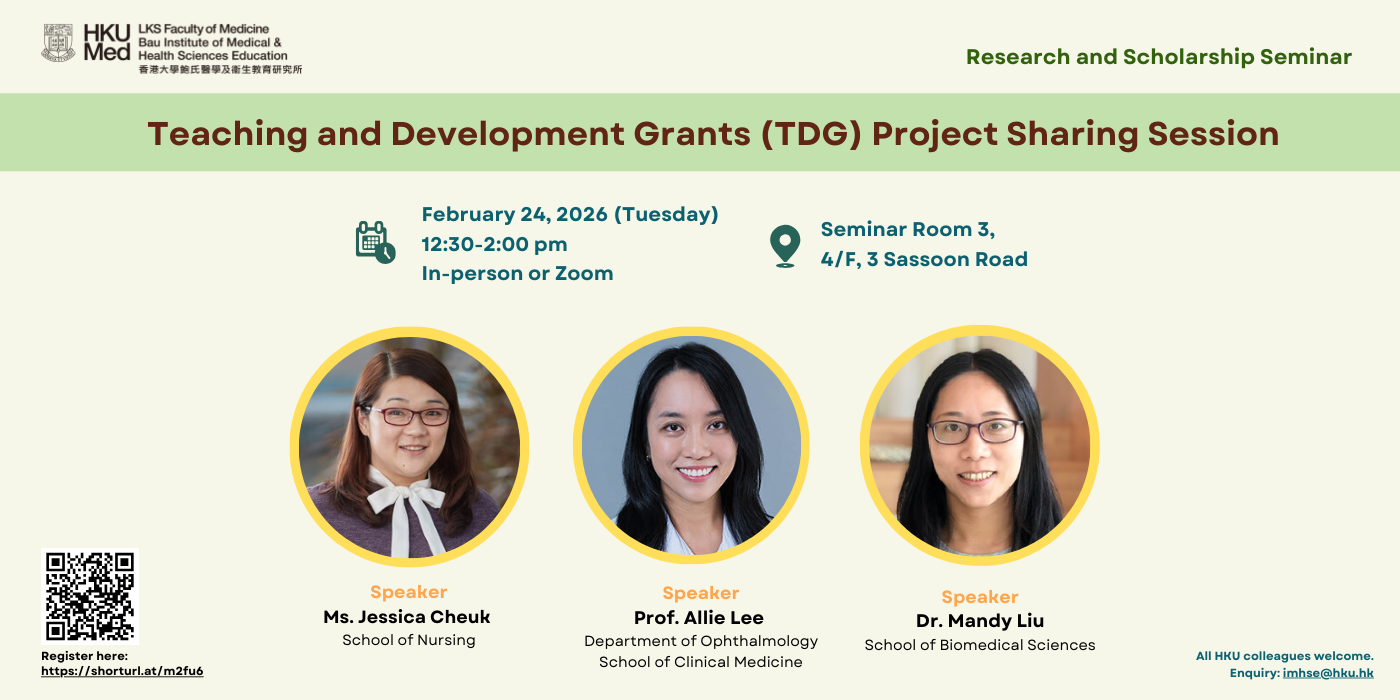

- Date / Time
12:30pm-2:00pm

- Location

- Abstract
This seminar aims to help Faculty colleagues who are planning a TDG project or who are just interested in medical education research. It will help provide insight into the design and thinking behind successful HKUMed TDG projects through the sharing by the following speakers:
Using the Virtual Gaming Simulation to Promote Self-regulated Learning
Ms. Jessica Cheuk, School of Nursing
In this project, we plan to develop a virtual gaming simulation which provides immersive learning activities to promote students’ self-regulated learning. The virtual gaming simulation will also be incorporated into Moodle. The teachers could monitor students’ learning progress and understand students’ learning needs.
The virtual gaming simulation uses film clips of standardised patients to provide students with an authentic experience to understand the role of a nurse and a sense of professionalism. It uses a branched-outcome decision-making model with around ten decision points per case. The interactive feature offers opportunities for students to perform assessments and make decisions about nursing care. The instant feedback assists students in understanding their current abilities and desired competence for a nurse in these scenarios. Therefore, it provokes students about meta-cognitive strategies in their learning, and enhances students to reflect on their personal goals and current conditions. It also facilitates students in identifying the resources for improvement.
The project is expected to support students to develop self-regulated learning by providing them “the power to oversee and steer one’s learning so that one can become a more committed, responsible and effective learner”.
The results of this project will provide helpful information for developing interactive teaching that promotes self-regulated learning and game-based learning in Moodle.
Development of an Innovative Eye Movement Simulator Using Hand Gesture Recognition
Prof. Allie Lee, Department of Ophthalmology, School of Clinical Medicine
Eye movement examination is a core clinical skill for all medical practitioners for the detection of life-threatening diseases and common medical conditions. However, students’ opportunity to learn and practice this essential skill has been limited due to lower patient availability, shorter clerkship time, and higher student volume. This project aims to fill this gap by providing an innovative tool to enhance learning.
The objectives of the project are: 1) To develop a first-of-its-kind eye movement simulator using hand gesture recognition that closely resembles real-life environment; 2) To introduce a new tool for teaching, self-practice and assessment of eye movement examination; 3) To evaluate the validity of the eye movement simulator as an effective teaching tool.
This pedagogical innovation is a cross-faculty (Medicine/Engineering) and interdisciplinary (Ophthalmology/Medicine) collaboration with students participating as partners. This simulator features a virtual patient with eyes that will follow the user’s hand. As such, the simulator demonstrates pathological eye movements found across a wide spectrum of diseases. The simulator was evaluated quantitatively using feedback questionnaires and test scores.
Findings from this project provides valuable new evidence on the use of hand-gesture-based medical simulators and insights on future modifications for adoptions at cross-faculty and university levels.
Utilizing CheckTab to Enhance Formative Assessment and Near-peer Teaching in a Large Cohort Setting
Dr. Mandy Liu, School of Biomedical Sciences
In dissection teaching, formative assessment can quickly identify students’ misconceptions, while instant feedback can correct these misunderstandings and prepare them for subsequent learning steps. These teaching strategies generally improve the quality of anatomy education, which play critical roles in enriching students’ learning experiences.
At LKS Faculty of Medicine, dissection is a significant component of medical students’ preclinical year curriculum. With over 300 students taught simultaneously by 6-8 teachers and a team of 3-6 near-peer anatomy teachers, each instructor is responsible for 5-8 dissection groups per session. Although the program has demonstrated efficacy, the vast amount of information and limited time make it challenging for instructors to pinpoint missed concepts or provide personalised feedback. Additionally, near-peer teachers may unintentionally overlook crucial concepts due to their own limitations, requiring additional review by the anatomy teachers.
To address these challenges, we propose implementing a tablet-assisted formative assessment system, CheckTab, for each dissection group. Utilising Microsoft Forms, this system incorporates a checklist and several multiple-choice questions that focus on essential dissection steps and key concepts. Immediate results collection from CheckTab enables instructors to identify missed concepts and learning difficulties when approaching each dissection group. This allows them to provide individualised feedback to all students at the onset of subsequent dissection or learning step. CheckTab also ensures that key concepts are covered by both anatomy teachers and near-peer anatomy teachers, guaranteeing that students receive consistent, high-quality anatomy education necessary for their future careers. Furthermore, CheckTab can be easily adapted for any scientific, knowledge-based laboratory or instructional settings, providing an innovative approach to formative assessment. The success of this initiative could serve as an example for other faculties and institutions seeking to integrate technology into formative assessment, enhance near-peer teaching programs, and promote student-centred learning.

- Speaker(s)
Ms. Jessica Cheuk
School of Nursing
Prof. Allie Lee
Department of Ophthalmology, School of Clinical Medicine
Dr. Mandy Liu
School of Biomedical Sciences

- Seminar Recording URL