
Teaching and Development Grants (TDG) Sharing Session
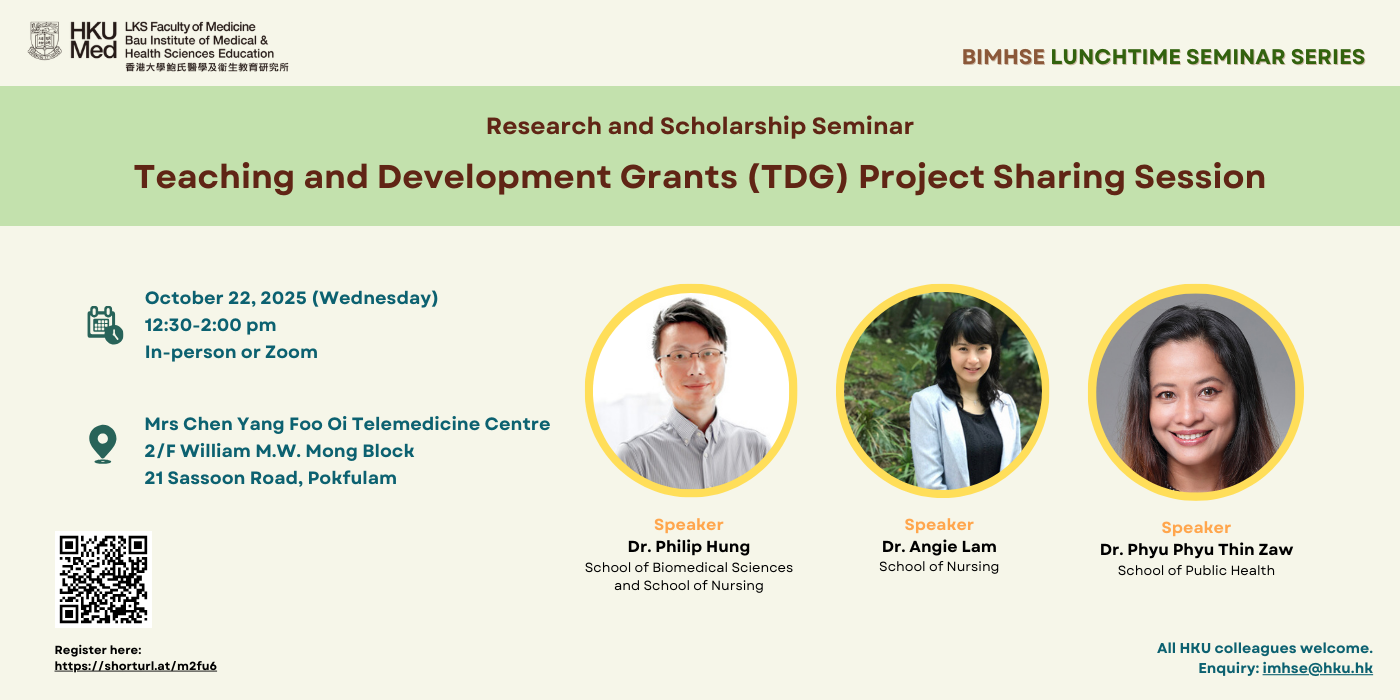

- Date / Time
12:30pm-2:00pm

- Location

- Abstract
This seminar aims to help Faculty colleagues who are planning a TDG project or who are just interested in medical education research. It will help provide insight into the design and thinking behind successful HKUMed TDG projects through the sharing by the following speakers:
Development of Electronic and Active Learning of Student-centered Interactive Gamification (EasiG) to Enhance the Learning of Cardiac Electrophysiology
Dr. Philip Ming Wai Hung, School of Biomedical Sciences and School of Nursing
The electrical activity of the heart is one of the most important physiological concepts in both curricula of medical and nursing students. The concept is a critical step for the students to understand the principles of electrocardiogram (ECG).
Electrocardiogram (ECG) is a commonly used non-invasive diagnostic tool to access the heart function in the clinical setting. Basically, ECG assesses the electrical activity travelling throughout the entire structure of the heart. Through assessing its electrical activity with ECG, the healthcare professionals can evaluate the heart function and identify abnormalities such as bundle branch block, so as to provide appropriate treatments accordingly. Yet, most students found the directions and the measurements of the electrical activity very complicated. Given the tight and compact teaching schedule in these two curricula, it is important to let the students learn this concept effectively and efficiently.
Electrical activity of heart and ECG are often taught in lectures. With such passive learning strategy in a fixed contact period of lectures, students were unwilling to ask for in-depth knowledge and impede their professional development. Without a well-developed and interactive electronic learning (E-learning) platform, the transformation from passive learning into active learning is always challenging to the teachers or instructors. The application of cutting-edge scenario-based 3D simulation by virtual reality (VR) technology is the key successful factor to implement the above active learning strategies in tertiary education. VR has been long recognized to allow immersive learning experience that has been proven to enhance active learning and teaching engagement.
In this project – Electronic and Active learning of Student-centered Interactive Gamification (EasiG), we aim to develop a user-friendly and interactive VR platform to enhance the understanding in the heart electrical activity and electrocardiogram. The design of the platform will cover both normal and abnormal examples of the 3D-simulated heart electrical activities with corresponding ECG patterns. The developed VR platform is aimed to provide an innovative teaching and learning method beyond the limitation of traditional didactic approach. To evaluate the usefulness and impact of the teaching material, we will introduce a pre- and post-test analysis to assess if the teaching material improves the knowledge of the students. To evaluate the satisfaction, we will introduce a survey to collect and analyze the feedbacks from users.
Rethinking the Nursing Curriculum and Pedagogy to Reduce Students’ Psychosocial Impacts in the Remote Learning Transition under the COVID-19 Pandemic
Dr. Angie Ho Yan Lam, School of Nursing
The COVID-19 pandemic has created devastating impacts on nursing students’ psychological wellbeing, social relationships and school life. Nursing students, and other health professional students, may be particularly vulnerable as they face additional learning challenges, including suspensions of hands-on practical sessions and clinical placements, replacing these experiences with virtual simulation programmes, remote learnings and new practicum mode in the community. The sudden transition impedes clinical transition, psychological readiness in real-world practice, and academic social interaction. These psychosocial impacts may affect students’ learning efficacy and subsequently their academic achievement and future job engagement.
There is an urgent need to shape the curriculum and pedagogies to address students’ psychosocial needs under remote learning transition. This proposal aims to understand the psychosocial conditions of nursing students during the pandemic and psychosocial factors that affect students learning and academic performance in remote learning. Most importantly, the project assesses the students’ psychosocial needs amidst remote learning transition to inform the priorities areas and resource allocation to shape the school’s policy, curriculum and pedagogies development.
Developing Innovative Teaching Methods for Occupational Medicine (OM) to Improve Student’s Knowledge and Skills in OM Counselling
Dr. Phyu Phyu Thin Zaw, School of Public Health
According to the evidence, most medical schools, including HKU, do not adopt any specific approaches to undergraduate occupational health teaching. Additionally, undergraduate programmes in occupational medicine encounter several challenges, namely lack of student interest and limited curriculum time. A study stated that occupational medicine has been poorly represented in undergraduate training. A study conducted in the UK also provided evidence of a reduction of undergrad medical students enrolled in the OM field. Such kind of declines could lead to medical practitioners being poorly prepared in management of occupational diseases. Since the need of well-trained doctors in the field of OM in the 21st century is highly important especially in industrialised countries, the abovementioned gaps should attract the urgent attention of higher education sector to reverse such kind of decline. Now is the time to give higher priority in the development of innovative teaching and learning methods of OM in undergraduate medical programmes. If innovative teaching and learning methods are used, OM could be satisfactory and attractive for medical students to nurture fundamental skills and advance their learnings in this field.
In this regard, we conducted an intensive literature review on different teaching methods of delivering OM and a further exploration of the Jigsaw teaching method as a cooperative learning strategy emphasising collaboration, active participation, and shared responsibility among students. A meta-analysis by Springer, Stanne, and Donovan (1999) found that the Jigsaw teaching method positively impacted academic achievement across various subjects and grade levels. Students who participated in Jigsaw activities consistently demonstrated higher levels of content knowledge acquisition compared to traditional instructional approaches. Likewise, Research by Slavin (1995) indicated that Jigsaw learning promotes the development of critical thinking skills. By engaging in collaborative problem-solving and discussions within their assigned groups, students learn to analyse information, evaluate different perspectives, and construct well-reasoned arguments. Thus, our study aims to develop new teaching materials using Jigsaw methods for OM enhancing student’s OM clinical and public health management skills, and evaluate the effectiveness of Jigsaw teaching method on students’ learning by comparing students’ knowledge, attitude and self-perception of achievement of learning objectives before and after the introduction of the new method. Within each tutorial, students will evaluate, too, if the use of Jigsaw method and case studies improved their knowledge, attitude and perception for OM cases.

- Speaker(s)
Dr. Philip Ming Wai Hung
School of Biomedical Sciences and School of Nursing
Dr. Angie Ho Yan Lam
School of Nursing
Dr. Phyu Phyu Thin Zaw
School of Public Health

- Seminar Recording URL