Teaching for Motivation and Engagement in Health Professions Education
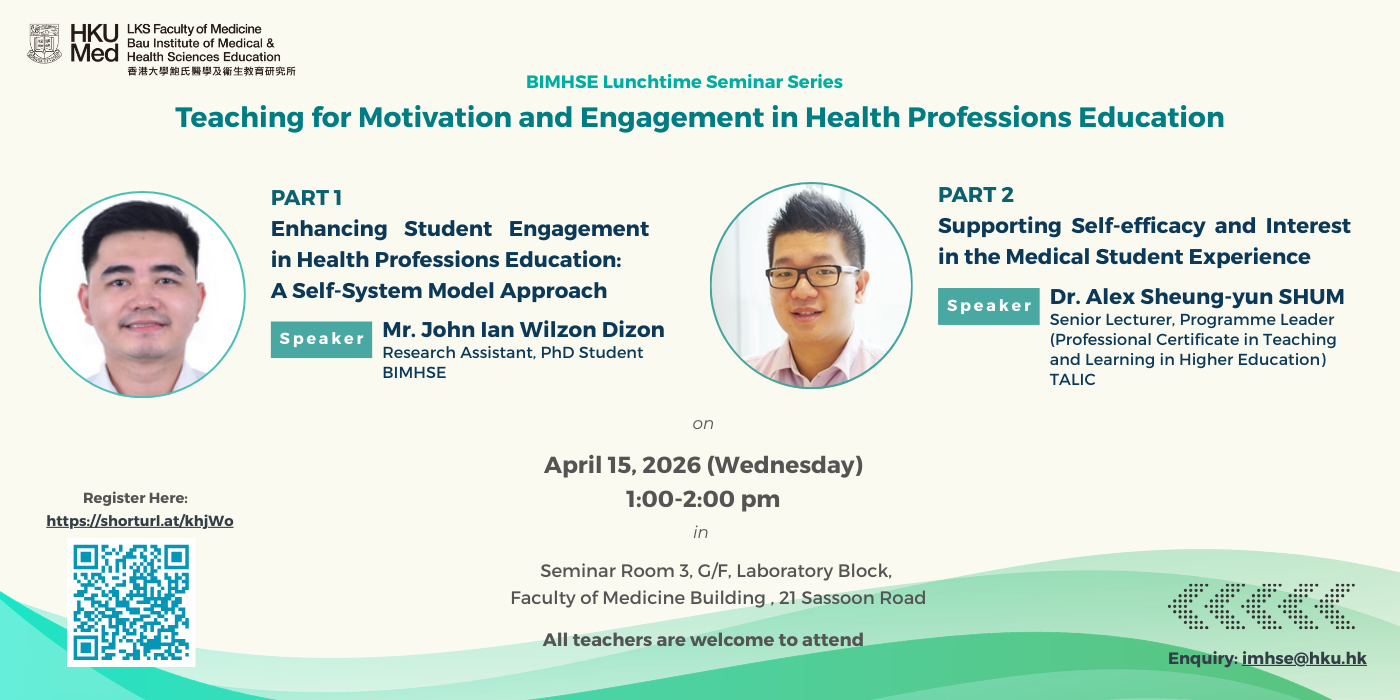

- Date / Time
1:00pm-2:00pm

- Location

- Abstract
Empirical research in educational psychology consistently shows that motivational and engagement variables—such as self-efficacy, interest, and different forms of engagement—explain substantial additional variance in students’ learning outcomes over and above intelligence quotient and prior achievement. Knowing how “smart” students are is not enough to predict how well they will learn, persist, or thrive in demanding programmes in health professions education. This underscores our responsibility as educators to understand these motivational processes and to design learning environments that actively trigger and support them.
This two-part Lunchtime Seminar Series focuses on strengthening student motivation and engagement across health professions education. Grounded in theories from Educational Psychology and supported by empirical evidence, the series will help educators intentionally shape key motivational and engagement drivers that influence how students feel, think, and behave in their learning. Participants will be introduced to theoretical frameworks, guided to examine their own teaching contexts, and supported to design small, practical changes that can immediately enhance students’ motivation, engagement, and self-beliefs.
Abstract:
Part 1 – Enhancing Student Engagement in Health Professions Education: A Self-System Model Approach
Presented by Mr. Wilzon Ian John DIZON
Motivated students excel academically, exhibit positive emotions, demonstrate resilience, persist through adversity, engage deeply in their studies, and embrace lifelong learning. Theory and empirical data support this assertion, making it imperative for all teachers to facilitate supportive teaching and learning contexts for its growth. This seminar introduces nursing educators to the Self-System Model of Motivational Development (SSMMD), a popular framework in Educational Psychology for fostering student engagement. Drawing from established motivational theory, participants will explore practical strategies to enhance students’ sense of competence, relatedness, and autonomy in both classroom and clinical settings. Through interactive exercises and real-world examples, attendees will learn to identify engagement-supporting practices while recognizing common pitfalls that may hinder student motivation. This evidence-based approach offers concrete tools for creating learning environments that prepare nursing students for the complexities of clinical practice. Participants will leave with actionable strategies to implement immediately in their teaching practice.
Part 2 –Supporting Self-efficacy and Interest in the Medical Student Experience
Presented by Dr. Alex Sheung-yun SHUM
Self-efficacy and interest answer two fundamental questions about student engagement and motivation: “Can I do it?” and “Do I want to?” Self-efficacy, students’ belief of their capabilities to succeed, is strongly linked to performance. Students’ self-efficacy further determines if they will invest effort, time, and persistence to learn. Interest is characterised by students’ longer-term desire to re-engage, and is tied to their knowledge, value, and emotions. Both of these motivational drivers are malleable, and teachers’ efforts can meaningfully influence them. The session will begin with a concise, non-technical description of relevant theories and HKU-context evidence. Participants will be guided to evaluate their teaching contexts and identify existing practices that support students’ self-efficacy and interest. Attendees will create small implementable changes that can strengthen these motivational drivers and improve the student learning experience.
Target learning outcomes
By the end of this seminar series, participants will be able to:
- Reflect on their own classroom and clinical teaching practices to identify factors that promote or hinder students’ motivation, engagement, and self-beliefs.
- Analyse their teaching and course designs using motivational frameworks introduced by the speakers (e.g. self-system model, self-efficacy, and interest development).
- Design at least one concrete, context-appropriate change to their learning environment to enhance students’ motivation, engagement, and self-beliefs.
All teachers are welcome to attend.

- Speaker(s)
Part 1 – Enhancing student engagement in medical education: A Self-System Model Approach
Mr. John Ian Wilzon DIZON is a PhD student and Research Assistant at the Bau Institute of Medical and Health Sciences Education (BIMHSE). He is engaged in supporting BIMHSE’s research and teaching and learning agenda. His research interests and publications involve scale development and validation, and empirical investigations in the field of medical and interprofessional education, educational psychology, mental health, and well-being.
Part 2 –Supporting Self-efficacy and Interest in the Medical Student Experience
Dr. Alex Sheung-yun SHUM is a Senior Lecturer at the Teaching and Learning Innovation Centre. He leads the Professional Certificate of Teaching and Learning in Higher Education. His research focuses on the interplay between students’ motivational trajectories and formative assessment in STEM education.
- Event Registration