
Teaching and Development Grants Sharing Session (2026 3rd Round)
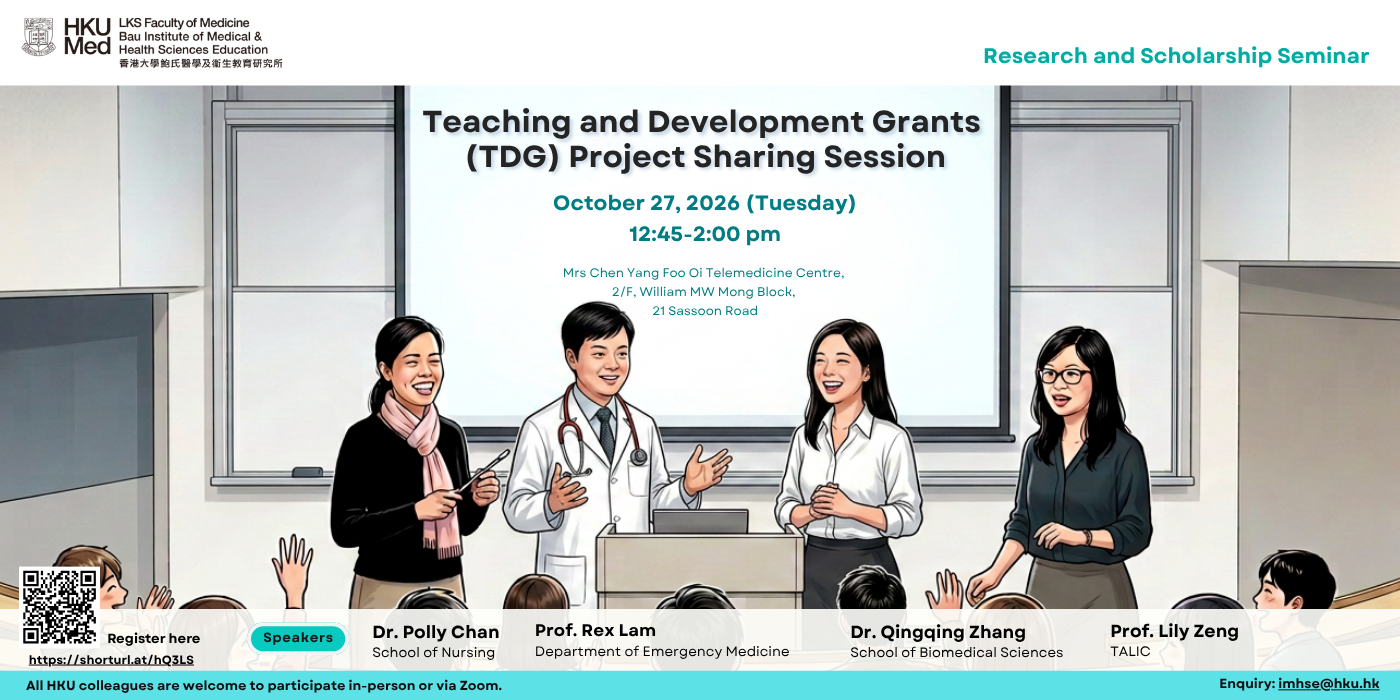

- Date / Time
1:00pm-2:00pm

- Location

- Abstract
This seminar aims to help Faculty colleagues who are planning a TDG project or who are just interested in medical education research. It will help provide insight into the design and thinking behind successful HKUMed TDG projects through the sharing by the following speakers:
Augmented Reality Smart Glasses Technology for Immersive Learning in the Emergency Department (AGILE-1)
Dr. Rex Lam, Department of Emergency Medicine, School of Clinical Medicine
The COVID-19 pandemic has disrupted traditional clinical teaching, depriving medical students of valuable clinical engagement with patients in the Emergency Department (ED). The current model of delivering teaching via livestreaming of resuscitation cases using an iPad requires two doctors for each small-group session, and is not sustainable given the increasing class size.
The Microsoft HoloLens 2 is an augmented reality (AR) head-mounted device (HMD) which enables a single clinical teacher to facilitate real-time distant immersive learning by medical students on acutely-ill ED patients while insulating them from infection risks. We aim to develop an AR HMD prototype based on HoloLens for clinical teaching and to evaluate knowledge gain, student mental load, satisfaction, motivation and tolerability. Ten pilot teaching sessions were conducted to optimise the workflow and establish a standard operating procedure for clinical teaching. A pilot cluster randomised controlled trial was subsequently conducted, in which final-year medical students were randomised to either AR-assisted learning using HoloLens or conventional face-to-face teaching during a 90-minute emergency airway management session.
The HoloLens-based AR immersive learning of aerosol-generating procedures (AGPs) resulted in knowledge gain and cognitive load comparable to face-to-face learning, despite receiving a lower student subjective rating of its learning effectiveness. It has the potential to be an alternative to face-to-face learning for AGP training when student access to high-risk clinical environments is restricted in future pandemics.
Enhancing Clinical and Cultural Virtual Encounter in Health Professional Students: 3 Is (Internationalization, Innovation, Interdisciplinary) in Action
Dr. Polly Chan, School of Nursing
The realisation of the HKU’s vision (2016-2025) is based on 3+1 Is: Internationalization, Interdisciplinarity and Innovation, which converge to create collective impact. This is an important direction for HKU teaching scholars to develop the strategic themes for enhancing the teaching and learning of students. Despite the devastating effects of the COVID-19 pandemic on different aspects of people’s lives, it creates increased opportunities to virtually connect local and international students in higher education with unique characteristics in terms of e-learning experiences without travelling abroad.
To enhance students’ effective learning in an online environment, the Community of Inquiry (CoI) has been cited frequently as one of the exclusive models that focuses on social presence, cognitive presence and teaching presence. Social presence focuses on developing students’ sense of connectedness and belonging that would promote collaborative learning. Cognitive presence aims to enhance students to participate more actively in online learning, leading to higher-order thinking and knowledge building. Teaching presence highlights developing students’ social and cognitive processes through a high-quality online instructional experience.
In this project, the 3Is will be incorporated into the CoI Model. One hundred and twenty health professional students from different health disciplines (Interdisciplinarity) and from Hong Kong, Mainland China and overseas (Internationalization) will be invited to go through two innovative intercultural and clinical case-based learning modules (Innovation).In the learning modules, case-based learning (CBL), covering two clinical scenarios with cultural dimensions and sharing commonalities of professional skills as a deliberate instructional design, will be adopted to enhance the online learning engagement of interprofessional students via a teamwork approach. The strategies for enhancing student learning will be devised based on social presence, cognitive presence and teaching presence, with a focus on clinical and intercultural learning, and student-as-partner initiatives.
To measure the project outcomes, quantitative data will be collected from students. They include: (i) interprofessional education (IPE) learning experience of students by Students Perceptions of Interprofessional Clinical Education Revised (SPICE-R); (ii) cultural awareness learning of students by Modified Cultural Awareness Scale (mCAS); (iii) online learning engagement of students by Online Student Engagement questionnaire (OSE). It is envisaged that the CoI incorporated 3Is can create a synergistic effect in supporting student learning.
Promoting Aging Research through Inquiry-Based Learning: Developing Interdisciplinary Logical Thinking in Academic and Industrial Settings
Dr. Qingqing Zhang, School of Biomedical Sciences
Aging has been implicated in multiple disease areas and is a leading economic burden in the future. There has been soaring attention to aging research as indicated by the ever-increasing number of publications indexed in PubMed from 2010 to the present. Yet, many anti-aging molecules are being validated in pre-clinical, and very few have been proven successful in clinical settings. With the difficulties in translating pre-clinical innovation to clinical success, it is essential to equip our students with logical thinking in both academic and industrial research.
We plan to explore more effective pedagogical methods for undergraduates from the School of Biomedical Sciences (Year 3-4) in this project. This project might benefit to other courses related to stem cell and entrepreneurial science, including BBMS3012, BBMS4005, and BIOL2409. This project aims to nurture BBMS students through academic-industrial setting about: (1) enhanced inquiry-based learning in aging research with the help of artificial intelligence; (2) hands-on experimental training for students to acquire laboratory skills; (3) student-initiated academic research projects with our innovative human cellular aging platform which shortens experimental period and maximizes student’s learning experience in research; and (4) research experience in industrial settings in Hong Kong Science and Technology Parks (HKSTP) to explore students with entrepreneurial science and gain experience in how academic research is translated into products.
This proposal aims to explore students with innovative ideas in biomedical science, particularly the use of stem cells to model the aging process. During the research experience, we plan to introduce students to the differences between academic and industrial research and equip students with the logical thinking skills necessary for interdisciplinary collaboration.
All HKU colleagues are welcome.

- Speaker(s)
Dr. Polly Chan
School of Nursing
Dr. Rex Lam
Department of Emergency Medicine, School of Clinical Medicine
Dr. Qingqing Zhang
School of Biomedical Sciences
Prof. Lily Zeng
Teaching and Learning Innovation Centre
- Registration Link