
Problem-based Learning
What defines effective teaching in a PBL-driven medical curriculum?
Effective teaching in health professions education prioritizes active, contextualized learning that bridges theory and clinical practice. While definitions vary, PBL-focused teaching at HKUMed emphasizes student-centered inquiry, collaborative problem-solving, and reflective practice to cultivate clinical reasoning and lifelong learning (Barrows, 1996; Hmelo-Silver, 2004).
What does effective PBL teaching look like at HKUMed?
At HKUMed, effective PBL educators:
1. Design authentic clinical scenarios that mirror real-world complexity (done already).
2. Facilitate self-directed learning by guiding students to identify knowledge gaps, critically evaluate evidence, and apply biomedical principles.
3. Foster interdisciplinary collaboration through small-group dynamics, emphasizing communication skills and peer feedback.
4. Integrate formative assessment to monitor metacognitive growth and adaptive expertise (Loftus & Higgs, 2020).
5. Model professional values by connecting ethical reasoning and patient-centered care to case discussions.
Theoretical Anchors for HKUMed’s PBL Approach
1. Barrows’ 6 core principles of PBL (1996): Problem-first learning, self-directed inquiry, tutor as facilitator.
2. Hmelo-Silver’s framework on scaffolding cognitive and collaborative skills in PBL (2004).
3. HKUMed’s 3C Model (Curiosity, Critique, Compassion) for nurturing clinician-scientists.
Effective PBL Teaching at HKUMed: Process & Evidence-Based Strategies
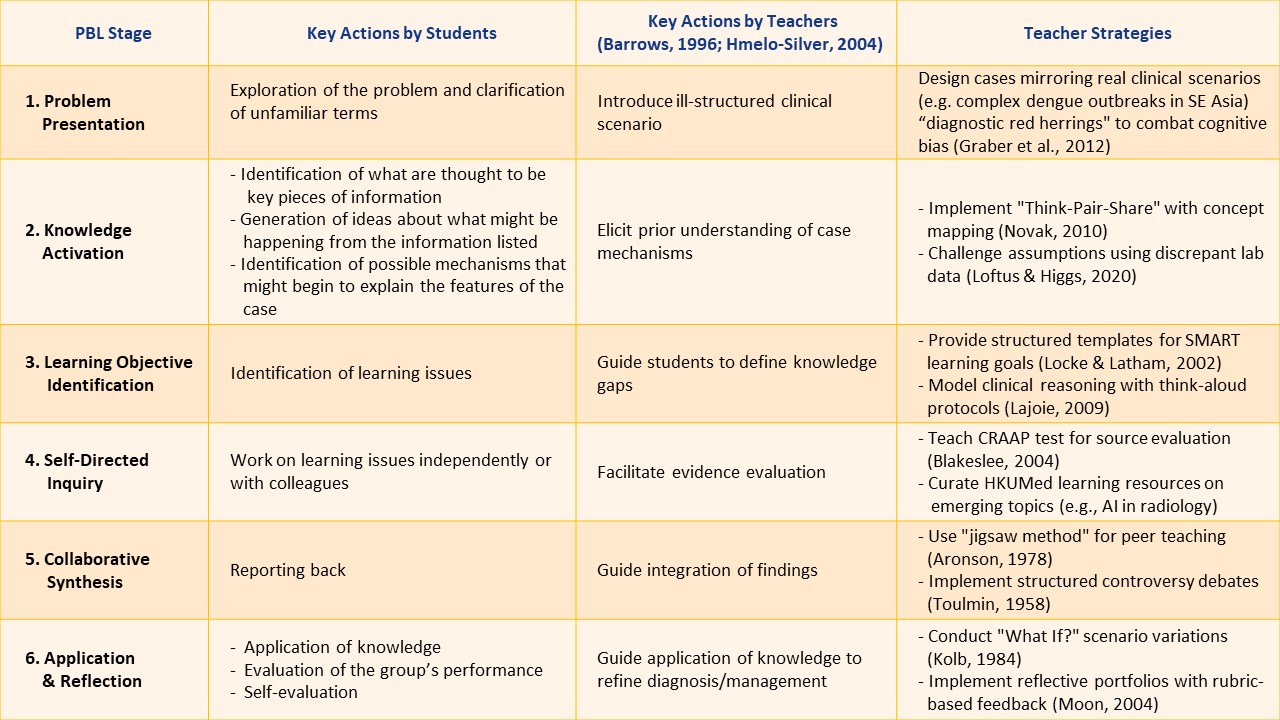
References:
1. Du, X., Nomikos, M., Ali, K., Lundberg, A., & Abu‐Hijleh, M. (2022). Health educators’ professional agency in negotiating their problem‐based learning (PBL) facilitator roles: Q study. Medical Education, 56(8), 847–857. https://doi.org/10.1111/medu.14792
2. Dwidmuthe, S., Dubhashi, S., Pusdekar, V., Tiwari, V., & Sahoo, S. (2025). Insight into “Problem-based Learning” in Medical Education – Students’ Perceptions about its Facilitators and Barriers: A Cross-sectional Study. Annals of African Medicine, 24(2), 350–355. https://doi.org/10.4103/aam.aam_140_24
3. Henderson, R. (2016). Problem-based learning : perspectives, methods and challenges. Nova Science Publisher’s, Inc.
4. Hmelo-Silver CE, Barrows HS. 2006. Goals and strategies of a problem-based learning facilitator. Interdisciplinary Journal of Problem-based Learning 1(1):21-39
5. Hmelo-Silver CE, Eberback C. 2012. Learning theories and problem-based learning. In Bridges S, McGrath C, Whitehill TL (ed). Problem-Based Learning in Clinical Education. The Next Generation. Dordrecht, Springer.
6. Moallem, M., Hung, W., & Dabbagh, N. (Eds.). (2019). The Wiley Handbook of problem-based learning. Wiley-Blackwell. https://onlinelibrary.wiley.com/doi/book/10.1002/9781119173243
7. Walker, A. (2015). Essential readings in problem-based learning: exploring and extending the legacy of Howard S. Barrows (H. Leary & C. E. Hmelo-Silver, Eds.). Purdue University Press.
8. Wei, B., Wang, H., Li, F., Long, Y., Zhang, Q., Liu, H., Tang, X., & Rao, M. (2024). Effectiveness of Problem-Based Learning on Development of Nursing Students’ Critical Thinking Skills: A Systematic Review and Meta-analysis. Nurse Educator, 49(3), E115–E119. https://doi.org/10.1097/NNE.0000000000001548
21 Sassoon Road, Pokfulam
Hong Kong SAR, China
Site Map
Follow BIMHSE
©2026 Bau Institute of Medical and Health Sciences Education, Li Ka Shing Faculty of Medicine, The University of Hong Kong. All right reserved.