
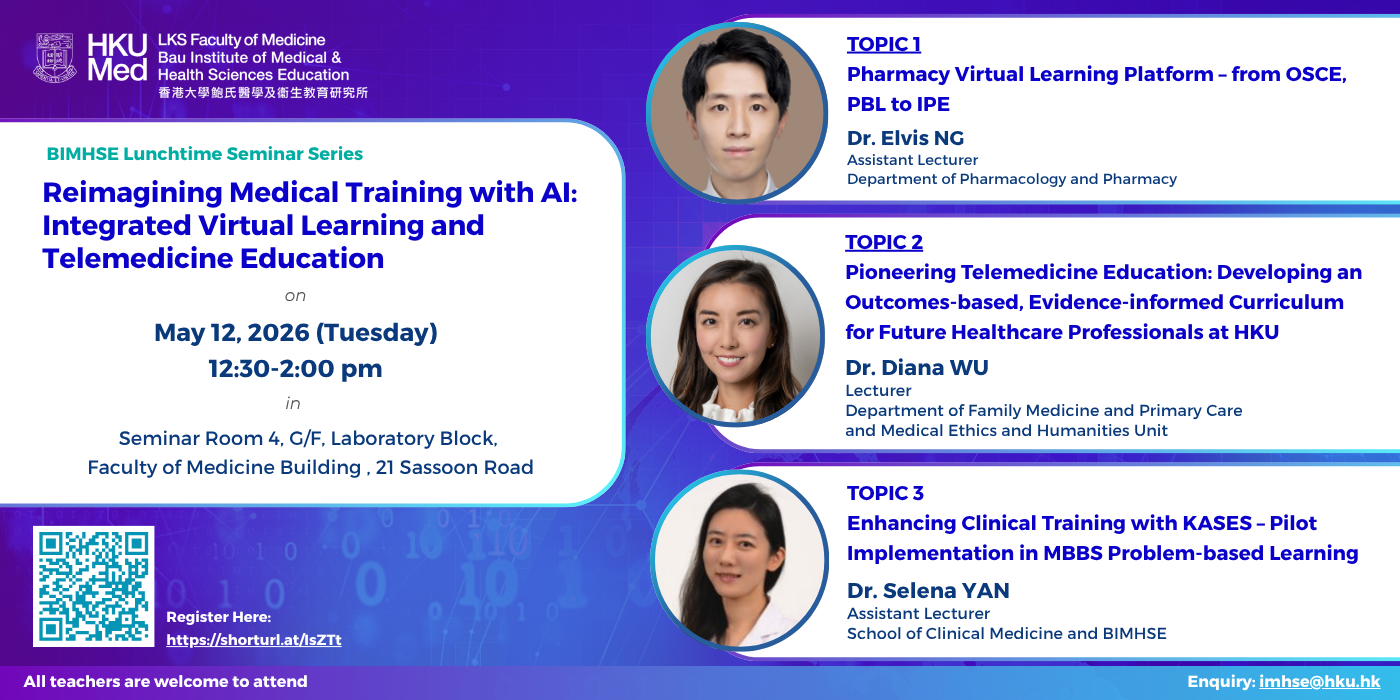
Reimagining Medical Training with AI: Integrated Virtual Learning and Telemedicine Education

- Date / Time
12:30-2:00 pm

- Location

- Abstract
Topic 1
Pharmacy Virtual Learning Platform – from OSCE, PBL to IPE
Presented by Dr. Elvis NG
Specialised, high-fidelity pedagogies such as Objective Structured Clinical Examinations (OSCEs), Problem-Based Learning (PBL), and Interprofessional Education (IPE) are central to contemporary medical and pharmacy education. Although each has distinct learning outcomes, they share a common set of challenges: they are resource-intensive, heavily facilitator-dependent, and typically delivered in small-group formats. Consequently, opportunities for students to engage in these activities are limited and often linked to formal assessment, creating high-pressure environments in which performance anxiety can impede genuine learning and skills development.
The rapid advancement of artificial intelligence presents a timely opportunity to address these limitations. This seminar introduces an all-in-one Pharmacy Virtual Learning Platform that uses generative AI to simulate OSCEs, PBL, and IPE in a flexible virtual environment. The platform enables students to practise clinical reasoning, communication, and collaboration without the logistical constraints of physical classrooms. While an overview of the full platform will be provided, particular emphasis will be placed on the Virtual PBL mode. Traditional PBL is frequently affected by unequal participation and students’ fear of judgement from peers; our AI-driven approach mitigates these issues by offering on-demand practice in a safe and private setting, simulated group dynamics that mimic real-world interactions, and personalised feedback to support targeted improvement. Designed to complement rather than replace live teaching, the platform aims to enhance students’ confidence and competence, thereby maximising the value of subsequent resource-intensive, in-person sessions.
Topic 2
Pioneering Telemedicine Education: Developing an Outcomes-based, Evidence-informed Curriculum for Future Healthcare Professionals at HKU
Presented by Dr. Diana WU
As telemedicine becomes a global standard of care, equipping future clinicians with digital consultation skills is critical. Yet in Hong Kong, telemedicine education remains fragmented and contextually underdeveloped. This research project pilots a longitudinal, outcomes-based telemedicine curriculum within the MBBS Family Medicine and Primary Care programme at the University of Hong Kong, aligned with international telehealth competency frameworks. The curriculum integrates e-learning modules, ethics workshops, and teleconsultation practicums. Rising student numbers and limited tutor capacity create a feedback bottleneck; to address this, a hybrid GenAI model separately analyses the student teleconsultation transcripts to deliver scalable, personalised formative feedback on clinical reasoning, communication, and empathy, with tutor validation prior to delivery. Evaluation follows Kirkpatrick’s four-level model, targeting feasibility, feedback quality, and learner and tutor acceptance. Preliminary findings show students like having the timely, personalized feedback and found it useful, although concerns about AI hallucinations and inaccuracies underscore the importance of having human oversight within AI-augmented educational workflows.
Topic 3
Enhancing Clinical Training with KASES – Pilot Implementation in MBBS Problem-based Learning
Presented by Dr. Selena YAN
Problem-based learning (PBL), centred on small-group clinical case discussions, is a core pedagogy at the HKU Faculty of Medicine. Traditionally, PBL relies on paper-based case vignettes issued page by page and lacks authentic patient interaction. Leveraging large language models and generative AI, we developed the Knowledge and Simulation Education System (KASES), an AI-powered virtual patient platform. KASES enriches PBL by simulating realistic doctor–patient encounters, whilst providing a safe environment for students to formulate differential diagnoses, select appropriate investigations, and interpret results in context. It reinforces hypothesis-driven training to strengthen students’ diagnostic skills and clinical reasoning, and prepare them for real-time decision making. We piloted KASES in small-group tutorials to evaluate feasibility, usability, and perceived educational value. Both quantitative and qualitative data were collected, and preliminary findings are being used to refine both the platform and its integration in pre-clinical training.
The audience is encouraged to bring their laptops to the seminar to try out the platform.
For enquiries, please contact us at imhse@hku.hk.
- Presentation Materials